Will My Home Battery Survive a Kona Low? What Hawaii Homeowners Need to Know About Flooding
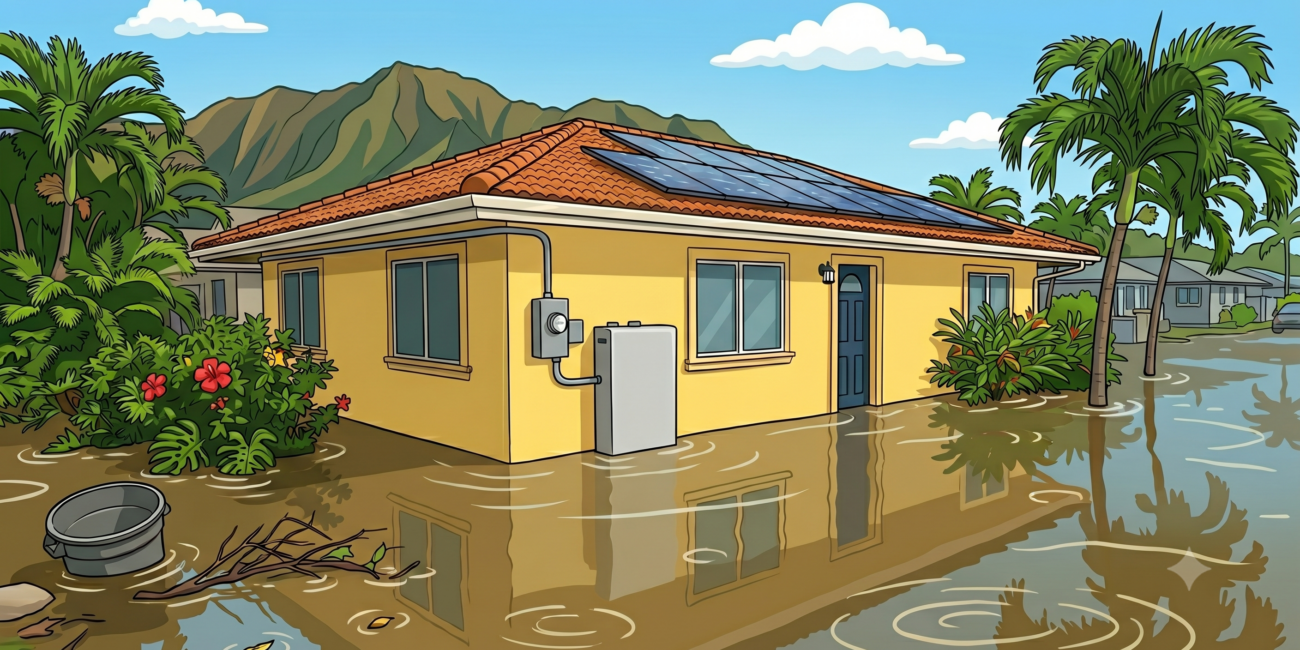
“Is my battery going to be okay?”
Short answer: in almost every case, yes. The longer answer is worth a few minutes of your time, because knowing what your battery is actually rated for will save you a lot of unnecessary worry the next time the National Weather Service starts using words like “catastrophic.” Let’s walk through it.What does an IP rating actually mean?
You’ll see “IP” numbers on the spec sheet for every battery we install. It stands for Ingress Protection, and it’s an international standard (IEC 60529) that tells you how well an enclosure resists two things: solid stuff like dust, and liquid stuff like rain.
There are always two digits after the letters. The first digit is for solids. The second digit is for water. Higher numbers mean more protection.
Here’s the cheat sheet for the water digit, since that’s what we care about during a storm:
5 means it shrugs off low-pressure water jets from any direction.
6 means it shrugs off heavy, powerful water jets (think the kind of sideways rain a Kona Low brings).
7 means it can be temporarily submerged in up to about 3 feet of water for 30 minutes without water getting inside.
8 means it can handle longer-term submersion under pressure.
So when you see something like “IP67,” the 6 means dust-tight and the 7 means temporary submersion is fine. That’s a serious rating. It’s the same rating most modern smartphones carry. One important thing to know: IP testing uses fresh water. Saltwater, mud, and the kind of red dirt soup that runs down our hillsides aren’t part of the test. So while the rating tells you the enclosure is sealed, it doesn’t mean the battery is invincible against everything Mother Nature throws at it.
How do the batteries we install actually perform?
We install three main battery brands here at Mālama: Tesla Powerwall (the Powerwall 2, the Powerwall+, and the new Powerwall 3), FranklinWH, and Sigenergy. Each one handles water a little differently. Here’s the real-world breakdown.
Tesla Powerwall 2, Powerwall+, and Powerwall 3
All three Powerwall models share the same core philosophy when it comes to weather sealing. The actual battery cells and power electronics inside the unit are rated IP67. That’s the temporary-submersion rating we just talked about. So if a few inches of water rises up around the base of your Powerwall during a storm, the part that does the work is fully protected.
The wiring compartment, where the conduit comes in and out, is rated a little lower at IP55 or IP56 depending on the model. That’s still very good. It can take heavy, wind-driven rain without an issue. But it isn’t designed to be sitting underwater for any extended period.
In plain English: a Powerwall mounted properly off the ground, getting hit by sideways rain or having water briefly splash up against it, is going to be just fine. Tesla even lists Powerwall 2 specifically as “Wet Location Rated” on its spec sheet. They don’t mess around with that label.


FranklinWH aPower 2
Franklin actually goes a step further than most manufacturers and publishes a specific number for flood tolerance. Their spec sheet lists flood resistance up to 29 inches from the base of the unit. That’s almost two and a half feet. Like Tesla, the battery pack and inverter are rated IP67, and the wiring is IP56.
Translation: if you have a Franklin battery and a couple of inches of floodwater come through your installation area during a storm, you’re comfortably inside the safety envelope the manufacturer designed for.
Sigenergy SigenStor
The Sigenergy battery is rated IP66 as a whole-system rating. That’s a strong rating for outdoor use and excellent for heavy rain. It means the unit is dust-tight and can handle powerful, sustained jets of water hitting it from any direction.
What it does not mean is submersion. If you have a Sigenergy battery, the rating doesn’t cover floodwater rising up around the base of the unit. It’s built for rain, not for sitting in a puddle. If your installation area is prone to standing water, that’s worth a conversation with us.

The Bottom Line
The batteries we install are built to handle the kind of weather Hawai‘i throws at them, and a few inches of water around the base during a Kona Low isn’t the disaster it looks like. If something ever does seem off after a storm, send us a photo or give us a call before you touch the unit yourself.